
Criminal Cases in the Lander County Courts
Lander County has no municipal courts because it has no incorporated cities. Argenta Township Justice Court handles Battle Mountain-area misdemeanors, traffic matters, warrants, and the first steps in felony and gross-misdemeanor cases. Austin Township Justice Court serves the Austin area in the same limited-jurisdiction role. Each justice court keeps its own case number and docket. A complaint, initial appearance, release order, and preliminary-hearing record may therefore stay in that court's file.
The Nevada Judiciary district court directory identifies the District Court layer. The Eleventh Judicial District Court holds the Lander County felony trial file after bindover, along with appeals from limited-jurisdiction court. Its Lander venue is at 50 State Route 305, Battle Mountain, NV 89820, and the clerk's number is (775) 635-1332. Court clerks, not the Sheriff or prosecutor, are the custodians for public dockets, filed charges, judgments, and sentences.
The Judiciary's official directory shows why a Lander County criminal case search must begin with court level and venue.
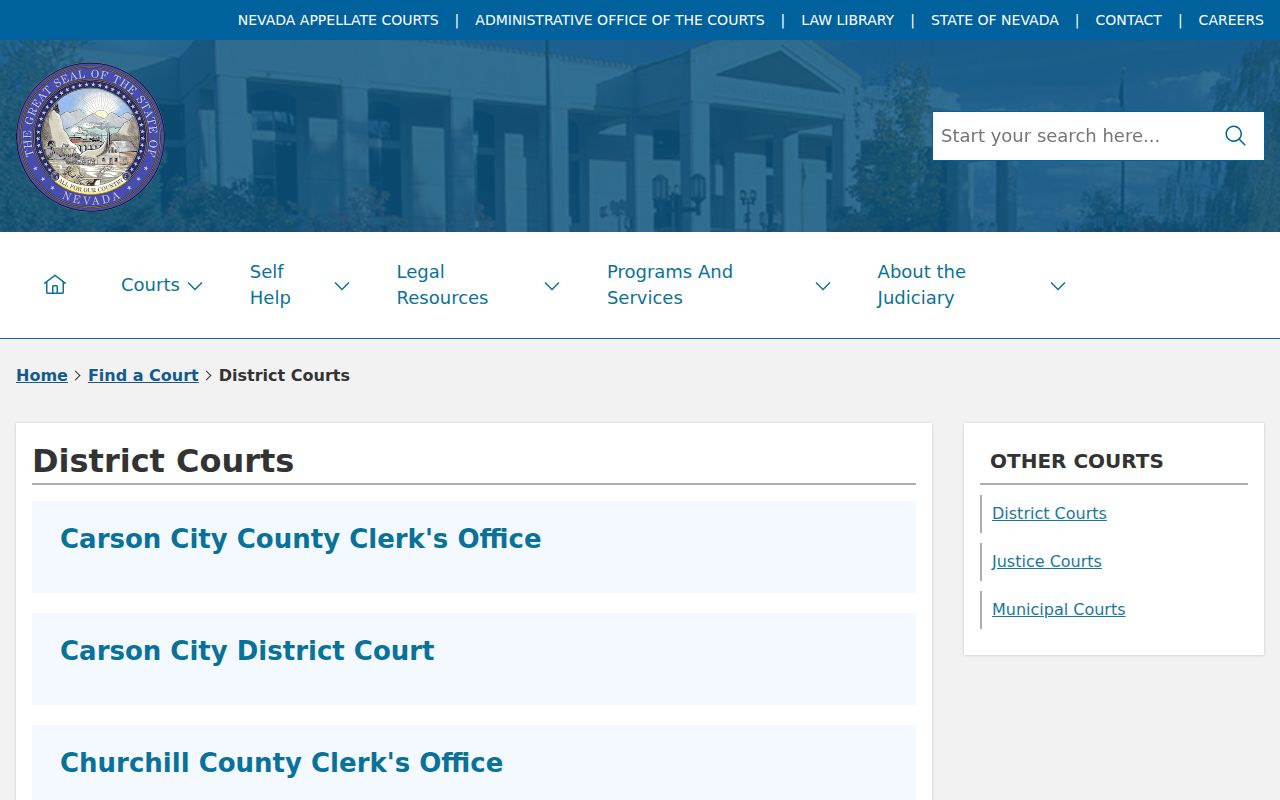
The directory is a routing tool, while the Lander County clerk remains the source for the actual trial record.
Lander County's Two-Court Case Trail
A serious Lander County prosecution can produce two linked court files. The township justice court receives the complaint and records the initial appearance, bail decision, and preliminary hearing or waiver. If probable cause is found or waived, the case is bound over. “Bindover” means transfer to District Court for the felony or gross-misdemeanor trial stage. The District Attorney then files the information, which is the formal charging document used in District Court.
Do not expect the justice-court number and District Court number to match. Ask the first Lander County clerk for the outcome and the later court number. This small step prevents a false conclusion that a case ended merely because the first docket stops after transfer. Fiscal year 2024 data show the local workload split: Argenta reported 33 new felony filings, 7 gross-misdemeanor filings, and 100 nontraffic-misdemeanor filings. Austin reported 1, 0, and 4 in those groups. These are Lander County case-flow counts, not counts of convictions.
Note: A preliminary hearing tests probable cause; it is not the felony trial and does not decide guilt.
How to Search Case Records
Nevada offers no unified statewide trial-court party-name portal. The Administrative Office of the Courts search guidance directs the public to the individual trial court. Start with any known sheriff event date or number, but treat it only as a lead. Then use the clerk channels in order:
- Identify whether Argenta or Austin Township Justice Court received the complaint, based on where the matter began.
- Ask that clerk to search the name, known date range, and any sheriff event number for the justice-court case.
- Obtain the docket, case number, outcome, and corresponding District Court number if the matter was bound over.
- Send the Eleventh Judicial District request form by email to records@11thjudicialdistrictcourt.net, or contact the Lander clerk by phone or at its counter.
- Request the register of actions first, select the pleadings or orders needed, choose plain or certified copies, and confirm the fee.
The official AOC material confirms that a statewide trial search is not available for Lander County criminal cases.
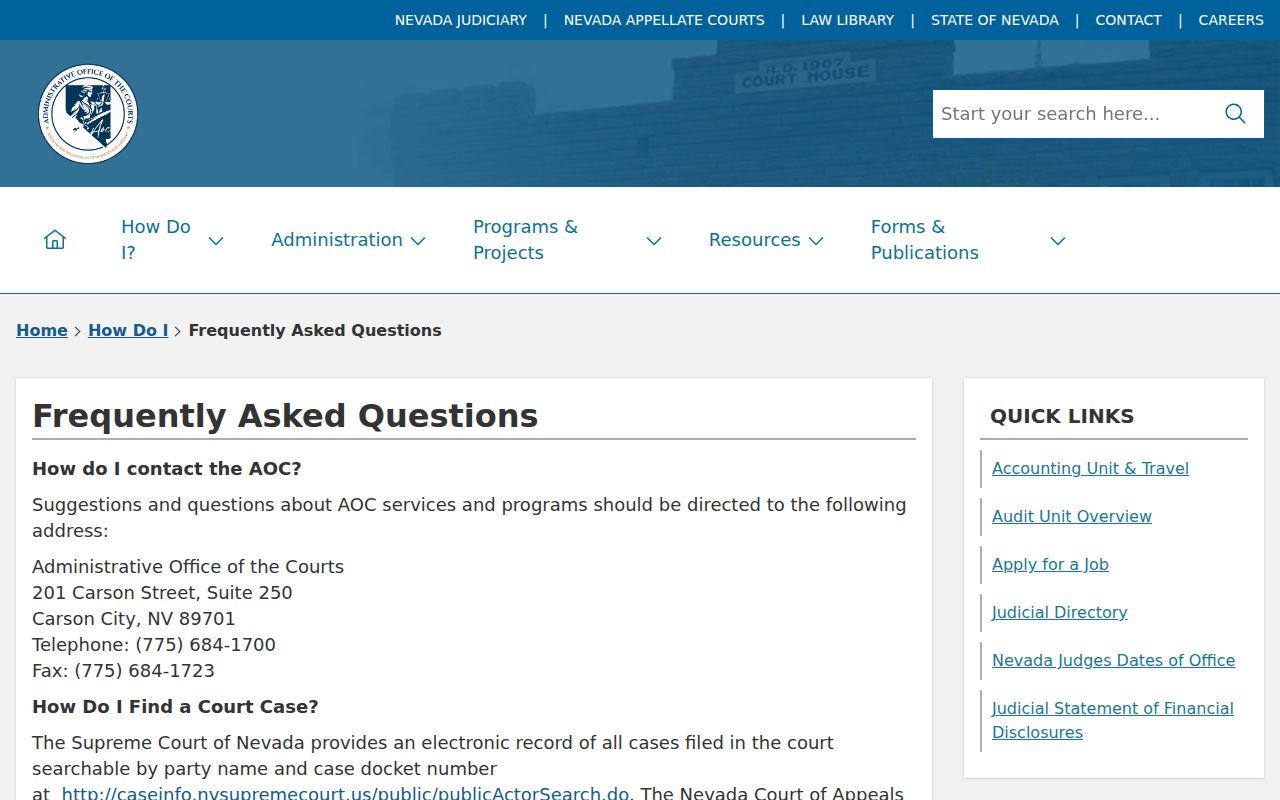
Its guidance supports the clerk-first path when a Lander County case does not appear in an online search.
Certified Lander County Case Dispositions
The Eleventh Judicial District publishes a Request for Records form for its Lander, Mineral, and Pershing venues. Choose Lander County. The form accepts a case number, case name, years to search, four lines for the documents sought, and a certified-copy choice. A precise request might seek the register of actions, filed information, judgment of conviction, and sentencing order. The form can be emailed to records@11thjudicialdistrictcourt.net.
The printed schedule lists $0.50 for each year searched unless the clerk waives it, $0.50 per copied page unless waived, and $3 for the clerk's certificate under seal. Ask for a Lander County quote before sending payment. Those terms belong to the District Court form and should not be assumed for Argenta or Austin Justice Court. A certified disposition bears the clerk's seal and is the clearest court-issued proof of the recorded result.
The official Eleventh Judicial District rules place Lander County within this three-county district.
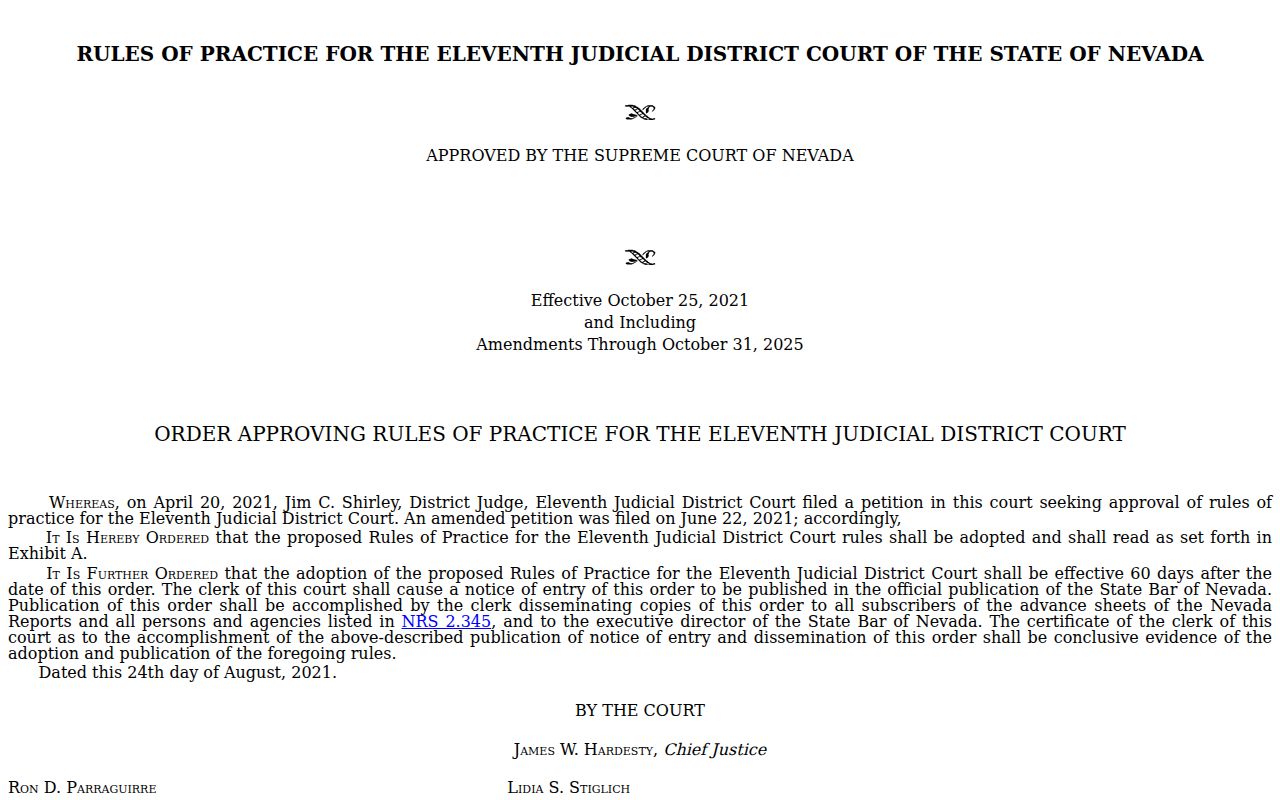
The rules give the Lander County request process its court setting, while the records form supplies the practical copy channel.
What the Case File Shows
A Lander County court file answers what was formally filed and how the court resolved it. Request the docket or register first because it lists events in date order. From there, select the complaint or information, plea, motion, order, judgment, and sentence that answer the specific question. A booking entry cannot replace this file. The Lander County public file may also identify counsel, including court-appointed counsel when the court found a defendant eligible.
| Case Number & Court | Identifies the custodian, venue, assigned judge, and the distinct court file. |
|---|---|
| Charging Document | Shows the complaint or District Court information and the statutes and categories formally pursued. |
| Docket Entries | Lists filings, motions, notices, minutes, orders, counsel, and the register of actions. |
| Hearing Dates | Records initial appearances, preliminary hearings, arraignment, motion settings, trial, and sentencing events. |
| Disposition & Judgment | Shows whether a charge was dismissed, ended in acquittal, or produced a conviction through plea or verdict. |
| Sentence & Conditions | May state custody, probation, fines, fees, restitution, and other terms imposed by the court. |
The Nevada Department of Indigent Defense Services listing documents Lander County's contract-counsel system.
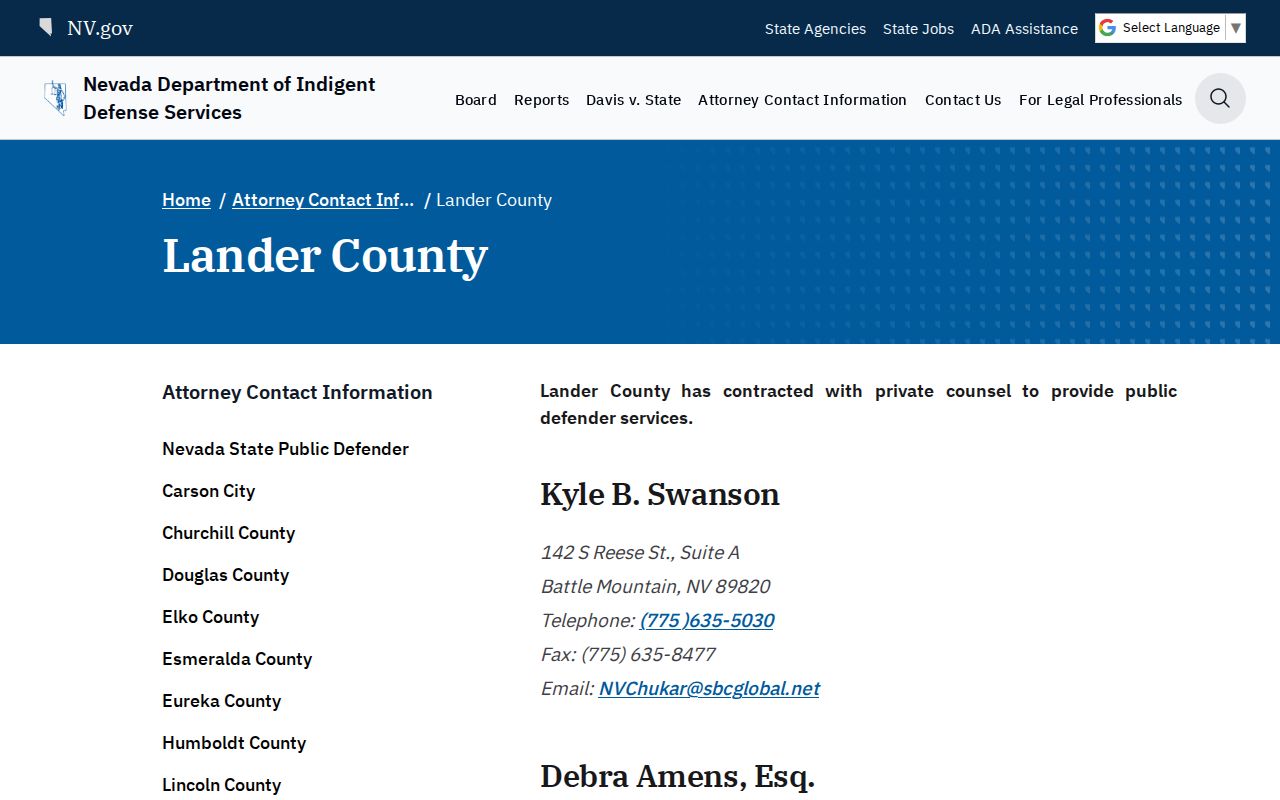
The Lander County court decides indigency and appoints counsel; the defense service is not a public case-record search office.
Lander County Filed Charges Matter
A Lander County booking charge reflects the reason recorded at jail intake. It is not necessarily the charge that the Lander County District Attorney later files. Prosecutorial review may change the count, statute, or Nevada offense category. A plea or judgment may change the result again. For that reason, use the complaint or information to state the filed charge and the final disposition or judgment to state the outcome.
Nevada classifies felonies from Category A through E. It also recognizes gross misdemeanors and misdemeanors. The class shown at arrest should not be used to infer the final penalty. The live offense statute and the court's sentence control. “Disposition” is the outcome of a charge, such as dismissal, acquittal, or conviction. A dismissal ends that charge without a conviction, but does not by itself erase the arrest or court event. A sealing order is a separate legal step.
Stages of a Criminal Case
A Lander County case may begin by arrest or citation, followed by an initial appearance and release decision. The prosecutor determines what to charge. For a felony or gross misdemeanor, the justice court holds or accepts waiver of a preliminary hearing before bindover. District Court arraignment follows the information. Discovery, motion practice, negotiation, or trial then leads to a result. Sentencing follows a conviction, while an appeal or postconviction filing may extend the record.
Case flow: Charges Filed → Arraignment → Pretrial → Plea or Trial → Disposition → Sentencing
The Lander County flow is a reading aid, not a promise that every criminal case will use every stage. A Lander County misdemeanor may remain in justice court. A dismissal may stop the path early. A felony resolved by plea will not reach trial. Read the docket dates and entries rather than assuming the next event occurred.
Note: An arrest event can predate the filed court charge, so compare dates as well as names and numbers.
Lander County Appeals Search
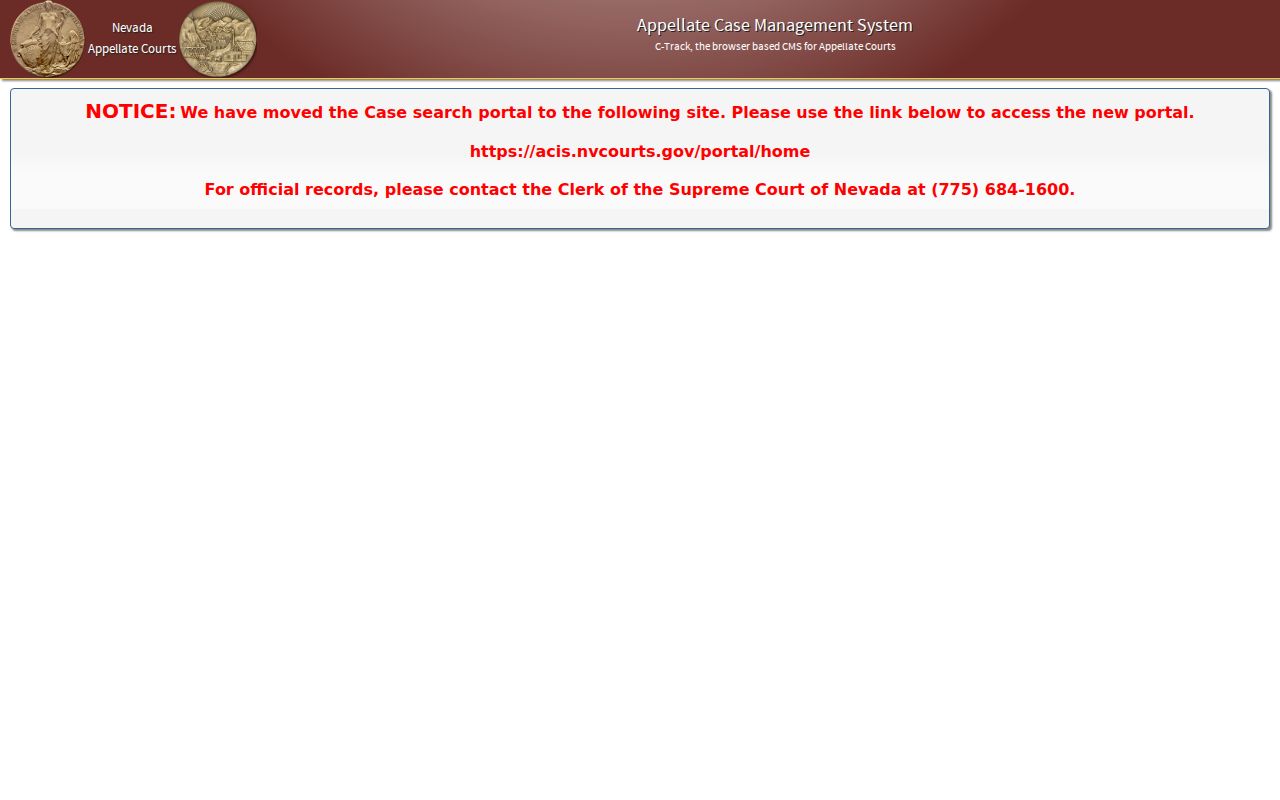
The Nevada Appellate Courts public portal covers Supreme Court and Court of Appeals cases. It does not search Lander County trial dockets. Use it only after the local docket shows an appeal notice or when an appellate number is already known. Public appellate results can show the caption, participants, filing events, orders, and many document images. Sealed or confidential documents do not appear.
| Field Label | Type | Required | Notes |
|---|---|---|---|
| Docket Number | Text | Alternative | Direct route when the appellate number is known. |
| Participant Name | Text | Alternative | Searches public appellate party names. |
| Search | Button | Yes | Runs the selected query. |
The portal allows free online viewing and printing. Judiciary guidance lists clerk-made appellate copies at $1 per page. That appellate rate is distinct from the Eleventh Judicial District form's local schedule.
The official appellate portal image shows the limited fields available for a Lander County criminal appeal search.
Starting here before checking the Lander County trial court can miss the entire case when no appeal was filed.
Older Lander County Case Files
An older Lander County file may be paper-based or archived. Give the Lander County clerk all known name spellings, the township, a narrow year range, and any sheriff event or prior court number. Ask for the docket first. It can reveal whether the desired order is in the justice-court file, the District Court file, or both. The District Court request form includes a “Years to Search” field because the time span can affect the search fee.
Geography can also cause mistakes. The 1871 courthouse in Austin is an important local landmark, but the county seat moved to Battle Mountain in 1979. The present District Court contact is the State Route 305 venue. Austin Justice Court may still hold an Austin-area limited-jurisdiction file, so confirm the custodian by phone before travel. If a case began before Nevada's fingerprint repository coverage generally starts in 1987, the original court and arresting agency become even more important.
Access & Restrictions
Public access to a Lander County judicial file depends on court rules and the court of record. The Nevada Public Records Act generally opens nonconfidential agency records, but the Administrative Office of the Courts explains that Chapter 239 does not govern the Judicial Branch in the same manner. Send a criminal case request to the clerk that maintains the docket, not to a general county records inbox.
Public copies can omit or redact sealed material, juvenile information, victim or minor identities, birth dates, Social Security numbers, addresses, medical information, and confidential presentence content. An empty online result does not prove that no Lander County criminal case exists. Ask whether the file is under a different spelling, remains in a township court, was moved to archive, or has been sealed. Nevada record sealing restricts general access but does not destroy every copy or permit unrestricted access to sealed content.
For a fingerprint-linked review of one's own statewide Nevada history, use the Nevada State Police Records Bureau process. That repository record and a Lander County court file serve different purposes: the repository groups reported arrest cycles and outcomes, while the clerk file preserves the pleadings, hearings, rulings, judgment, and sentence.